In a landmark moment for global assistive technology, the winner of the £1 million Longitude Prize on Dementia was announced at an inspiring celebration event at London’s Design Museum.
Bringing together leaders from across health, technology, research and policy, the champion the culmination of this exciting challenge. The evening featured contributions from speakers including Alzheimer’s Society celebrity ambassador Anna Richardson, Dr Zubir Ahmed MP, Parliamentary Under-Secretary of State for Department of Health & Social Care, Michelle Dyson CB from Alzheimer’s Society, Dr Cynthia Bullock from Innovate UK and Caroline Purslow from Challenge Works. The evening also featured a compelling panel discussion on the future of dementia healthcare, bringing together four experts – Mel Barsky, Director for Centre for Aging + Brain Health Innovation and Prize judge; Debbie Abrahams, MP for Oldham East & Saddlesworth; Trevor Salomon, Lived Experience Advisory Panel Chair; Tris Dyson, Founder and Executive Director of Challenge Works – all joined by chair Fiona Carragher, Chief Policy and Research Officer for Alzheimer’s Society.
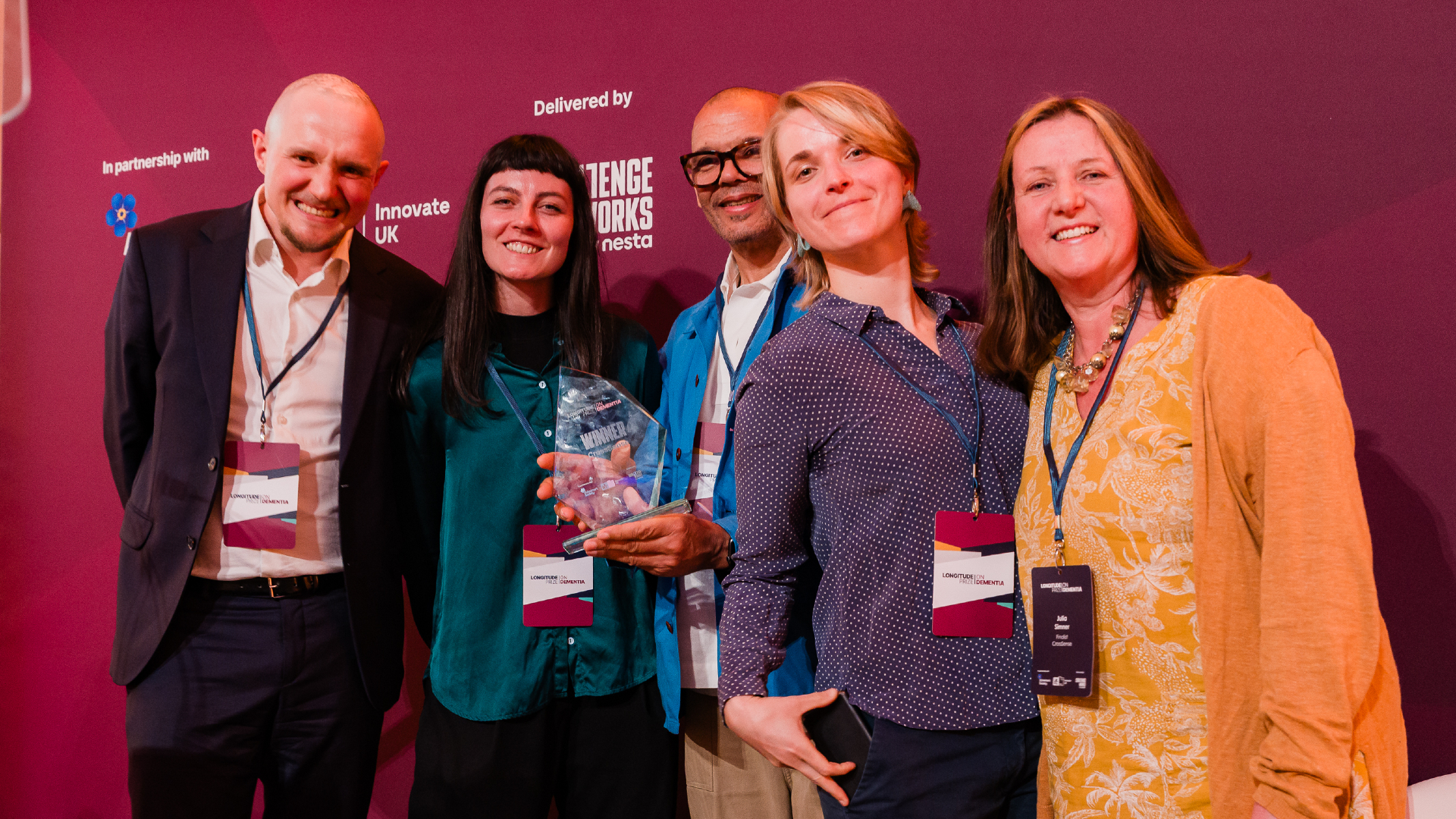
Across the evening, speakers reflected on the journey of the Prize and the growing role of innovation in supporting people living with dementia to maintain their independence for longer. On behalf of the Longitude Committee, Professor Dame Wendy Hall awarded the £1 million grand prize to CrossSense, a personalised AI assistant designed for smart glasses that helps people living with early-stage dementia navigate everyday life. The technology identifies objects in the user’s surroundings and gently guides them through daily activities, with the aim of helping people live safely and independently in their own homes for longer.
Through gentle, conversational prompts, CrossSense's AI companion - called Wispy - learns each person’s unique routines and preferences. Over time, the AI adapts to the user’s needs as their dementia progresses, providing personalised support tailored to how they live.
Using the smart glasses’ camera, the system captures and interprets the user’s environment in real time. This allows the AI to support everyday moments that are central to independence, from feeling confident moving around the home, to planning the day and completing tasks.
CrossSense has been developed by the London-based social enterprise, CrossSense Ltd. The team trained the technology with dozens of everyday activities including getting dressed, managing household chores safely, making a cup of tea and interacting with loved ones. Wispy asks helpful questions and offers prompts so that the user makes their own choices - and talks through what to do when a person cannot remember a particular step in a process.
The interactive, talkative and patient AI companion offers cognitive stimulation to get people thinking, talking and imagining, so that individuals continue to see the relationships between things (e.g. kitchen, mugs, spoons, teabags, water, kettle and milk are all connected to making a cup of tea), which helps to maintain neural connections, slow cognitive decline in early-stage dementia and improve quality of life.
Working with the University of Sussex and a panel of people affected by dementia, the team observed improvements in some users’ ability in naming objects, and other cognitive abilities in visual-spatial understanding, short-term and working memory - a component of memory that allows individuals to actively use information in the moment, such as following a conversation, solving a simple calculation, or remembering instructions.
Winning the Longitude Prize on Dementia is a dream come true. As a small team with big ambitions, the Prize’s support has accelerated CrossSense in ways that wouldn’t have been possible otherwise. The technology is designed to support daily living, integrating multiple senses to simplify essential tasks. We’re grateful to the people living with dementia and their families who helped shape it. This win brings us closer to making CrossSense available to the public within the next year.
The Prize’s panel of international expert judges agreed that the winning solution was a genuine breakthrough technology with revolutionary potential for people living with dementia and their families.
Dementia is a progressive condition and there is currently no cure. Around one million people in the UK are living with dementia and this number is projected to rise to 1.4 million by 2040[1]. The number of people worldwide living with dementia is projected to rise significantly from approximately 57 million in 2019 to over 150 million by 2050.
The Longitude Prize on Dementia is funded by Alzheimer’s Society and Innovate UK and is delivered by Challenge Works. It has driven the creation of personalised, technology-based tools that are co-created with people living with dementia, helping them to maintain their independence at home.
Rapid advancements in AI will give people affected by early-stage dementia the opportunity to stay safely in their own homes for longer and lead more independent, fulfilled lives. The CrossSense smart glasses companion is a prime example of harnessing technology to develop intuitive personal support that complements care given by humans. By anticipating people’s needs as their condition progresses, easing daily living challenges and providing additional reassurance to families, this revolutionary tech will allow people with dementia to maintain their independence for longer within the familiar environment of home.
Since 2022, the £4.4 million global prize has funded and supported the development of 24 different assistive technologies. Each received £80,000 to develop ideas that use AI and machine learning to help people living with dementia remain independent for as long as possible.
Five finalists were announced in 2024, each receiving a further £300,000 to develop their ideas into real-world products. While the finalists have developed very different solutions, they share the common goals of helping people living with dementia remain in their homes longer, continue meaningful daily activities and maintain social connections.
Throughout the Prize, an international Lived Experience Advisory Panel (LEAP) has reviewed innovator designs, ideas and provided insights into how technologies could support and enable independent living for a person with a diagnosis of dementia.
Made up of 11 people living with dementia, carers or former carers, the LEAP’s role is to ensure that people with direct experience of the condition were involved at every stage of the competition. While not a part of the judging process, LEAP insights were shared with the judges to inform decision-making throughout the Prize.
The £1 million grand prize will support the winner to make CrossSense available to the public in early 2027. In the future, the technology could also be used by local authorities, care providers and NHS services such as memory clinics, helping more people living with dementia maintain their independence and continue living safely at home for longer. Find out more about CrossSense
Discover more about the Longitude Prize on Dementia and all five finalists