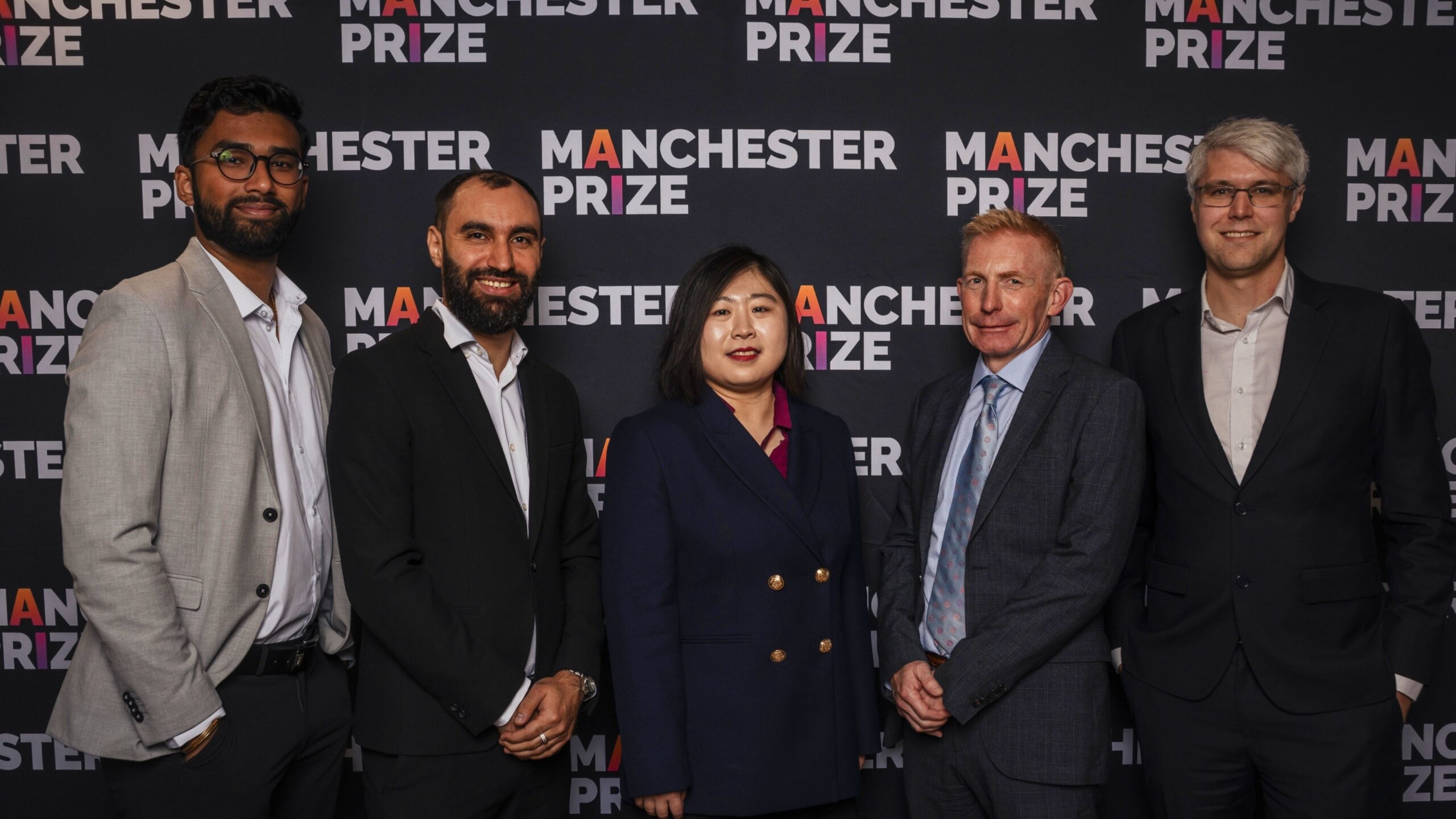
A University of Surrey spinout helping biogas operators generate more renewable energy, reduce emissions and improve profitability has today been named the winner of the second Manchester Prize.
BiofuelAi has secured the £1 million prize for its AI-powered platform that transforms how anaerobic digestion plants are managed, helping operators make better decisions in real time and unlock greater value from existing renewable energy infrastructure.
The Manchester Prize is the UK government's flagship AI challenge prize, funded by the Department for Science, Innovation and Technology and delivered by Challenge Works. The prize rewards groundbreaking UK-led innovations that use artificial intelligence to deliver public good.
Turning AI into real-world impact
While artificial intelligence often powers digital services and consumer applications, BiofuelAi demonstrates the technology's potential to solve practical industrial challenges with significant environmental and economic benefits.
Anaerobic digestion plants play an increasingly important role in the UK's renewable energy system, converting food and agricultural waste, as well as wastewater, into biogas. Yet managing these facilities remains highly complex, with operators often relying on experience and intuition to guide decisions.
BiofuelAi's platform combines machine learning, mechanistic modelling and digital twin technology to provide operators with a real-time understanding of what is happening inside their digesters and what actions are most likely to improve performance.
The result is a powerful decision-support system capable of optimising both short-term operational decisions and longer-term planning.
Pilot deployments have already demonstrated revenue increases of 6–10 per cent, profit improvements of 7–13 per cent and carbon emission reductions of 28 per cent.
A breakthrough for the biogas sector
For BiofuelAi's founders, the Manchester Prize represents both recognition of years of research and an opportunity to accelerate deployment of the technology across the energy sector.
"The biogas industry is one of the least data-driven sectors in energy. Plants that generate the heat and power for thousands of homes are still largely managed through spreadsheets and operator experience. BiofuelAi changes that. Winning the Manchester Prize validates the work of an exceptional team and accelerates our mission to make green energy more affordable, more consistent and more accessible," Alan Beesley, CEO and co-founder of BiofuelAi. The company was founded from the University of Surrey's AI4AD research programme and brings together expertise in artificial intelligence, mathematical modelling and biogas operations. "Anaerobic digestion is more like brewing than chemistry. What goes in takes days or weeks to show up in what comes out, which makes reliable prediction genuinely hard. We spent years developing models that could change that, combining physics with machine learning in ways the industry had not attempted before. The Manchester Prize win matters because it says the science is ready to become a product. We are now deploying in live plants and the results are tracking with what our models predicted," Professor Michael Short, Chief Technology Officer and co-founder of BiofuelAi. The technology BioFuelAi has built could supercharge our mission to power Britain with clean, affordable energy, helping green energy plants produce even more power and cut carbon emissions. And they are just getting started. The Manchester Prize was created to find exactly this kind of innovation. Not AI as an abstract idea, but something that delivers results. This is British AI leadership in practice: world-class researchers tackling hard challenges and helping to build the industries of the future.
Supporting the UK's energy transition
The challenge facing the UK's energy system is not only about developing new technologies, but also about making better use of the infrastructure already in place.
BiofuelAi's solution shows how AI can help unlock greater efficiency from existing renewable energy assets, improving energy security while supporting the UK's net-zero ambitions.
The company estimates that by 2030, its platform could help mitigate 293,000 tonnes of CO₂ equivalent emissions annually across the UK while generating more than £500 million in value for clients over five years.
BiofuelAi is already deploying the technology at commercial sites, with new installations underway and a UK reseller agreement in place.
Celebrating and incentivising UK AI innovation
BiofuelAi follows inaugural Manchester Prize winner Polaron, whose AI technology dramatically accelerates the development of advanced materials for batteries and other clean technologies.
Together, the first two Manchester Prize winners demonstrate the breadth of opportunity for artificial intelligence to tackle some of society's biggest challenges. From advancing clean energy infrastructure to accelerating scientific discovery, these innovations showcase the UK's growing strength in translating world-class AI research into real-world impact.
BiofuelAi stands as a compelling example of how British innovation can deliver economic growth, environmental benefits and public good.
Britain does not lack brilliant ideas. What we often lack are mechanisms that help those ideas make the leap from research papers into products, businesses and economic growth. That's where challenge prizes can play a unique role.
The Manchester Prize is designed to identify breakthrough technologies with the potential to deliver public good and help accelerate their path to impact. BiofuelAi demonstrates exactly why that matters. By applying cutting-edge AI to a real-world energy challenge, the team has shown how research developed in a UK university can become a commercial solution with the potential to deliver environmental, economic and societal benefits at scale. Congratulations to the BiofuelAi team on becoming the second Manchester Prize winner.