
Data Driven Farming Prize

Data Driven Farming Prize

A pair of hands operate a mobile phone in front of a field of rapeseed

What was the Data Driven Farming Prize?

In an initiative to combat global hunger and poverty, we launched the $3 million USD Data Driven Farming Prize in February 2017. It was funded by USAID, and we helped to deliver it alongside Feed the Future.

What happened?

International teams of innovators created technological solutions to help farmers in Nepal use data and information more effectively to improve their productivity.

Four winners from Nepal, Canada and Germany we announced in September 2017.

Why did we do this?

Global concern regarding agricultural and food production is growing. Nepal has the potential to be a food surplus country if smart, sustainable intensification that includes smallholder farmers can be realised. This challenge aimed to bring about systemic change for smallholder farmers by supporting the development of digital solutions which translate agricultural data and information into actionable insights. The prize encouraged innovators to explore new approaches, or scale best practices – raising awareness of the potential of digital technologies for agricultural benefits.

What did we learn?

  • Finalists found the prize useful and leveraged their experience, new networks, and partnerships to further accelerate the development of their respective solutions.
  • The prize enabled an innovation process that acted as a catalyst to the collective action needed to transform farming systems by combining them with the enabling power of new technologies.
  • The Data Driven Farming Prize has signalled to actors that the Nepali agricultural sector is a space for innovation – as a result, new projects are being launched to further build and strengthen the market.

Sign up to our newsletter to be the first to know about future challenges.

Contact Us

This challenge was funded by

USAID logo

Impact of the Prize

  • All solutions produced during the prize were innovative, as 13 new prototype solutions and complete business plans were created.
  • During the prize process, we directly tested innovations with a pool of 150 users, with the insights from the innovation testing reaching more than 2,000 smallholder farmers.
  • All of the 12 participating finalists continue to want to work in Nepal. By bringing their new and innovative solutions to the agricultural space, they have continued to focus on ensuring their end-users.
  • Finalists noted that testing phase was largely positive, as users found their solutions useful and insightful. They also noted they are continuously improving their solutions as they seek to create the ideal product for their end-users.
  • The prize precipitated 15 partnerships with various actors in Nepal’s agricultural value chain among 70% of the innovators. In addition, the prize supported finalists in building useful skills for professional growth (cross-data validation, user-testing, co-design, and impact evaluation) which better allowed them to ground the solutions in the Nepali context.
  • All of the finalists saw working in Nepal’s agricultural value chains an opportunity to be part of a transformation that could both revolutionize agriculture and also support farmers in numerous informational challenges they face in different agricultural value chains.
  • Since the prize ended, finalists established 22 new partnerships in Nepal’s agricultural space, ranging from cooperatives, the government, and the private sector.
  • Three finalists confirmed they had access to new funding due to the prize and the prize received $246,000 in-kind support from partners (equivalent to 17% of USAID total investment). At the end of the prize, the program ROI (return on investment) was calculated as the effective programmes cost was $1,240,000 equal to $155,000 per outcome the prize was aiming to achieve (8 outcomes as highlighted in the Theory of Change).

The winners
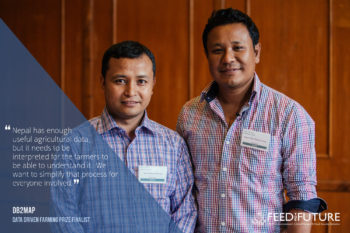
Two winners from Db2map smile at the camera

Viable Solution – Db2Map (Nepal)

Db2Map’s solution is GeoKRISHI, an integrated data-driven agriculture intelligence system for Nepal to improve crop productivity.
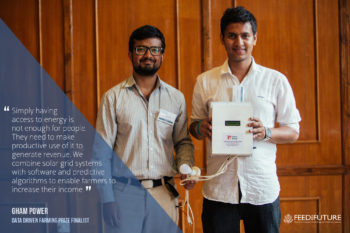
Two winners from Gham Power smile at the camera

Significant potential – Gham Power (Nepal)

Gham Power Nepal designed Off-Grid Bazaar, a platform that helps small farmers improve their yield by selecting an optimal mix of crops and agro-processing systems.
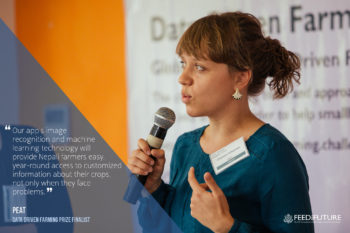
A winner from PEAT talks to the audience. She is using a microphone.

Viable solution – Peat (Germany)

Peat is a mobile crop diagnostic application for farmers worldwide.
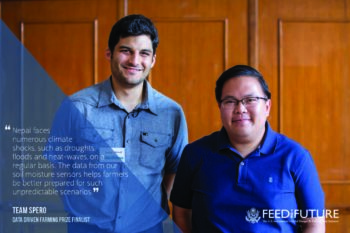
Two winners from Team Spero smile at the camera

Significant potential – Spero Analytics (Canada)

Spero Analytics designed a wireless soil moisture mesh network that enables precision agriculture among smallholder farmers in Nepal.

The finalists

  • Dreamwork Solution’s solution aims to improve efficiency and productivity of the farmers using Information and Communication Technology.

  • eKutir Global’s solution, FarmChalo, is human digital platform and data intelligence connecting knowledge, markets and finance to smallholder farmers.

  • Farming Online created the Annapurna App, which uses machine learning to improve food crop production on Nepalese smallholdings

  • ICT For Agriculture is a mobile and web platform capable of providing localized core content for farmers in Nepal.

  • iDE designed IPMobile, a mobile integrated pest management solutions.

  • Intrepid GeoInformatics is a web portal for farmers living in the peri-urban Kathmandu Valley to manage vegetable production.

  • R&D Innovative Solution created Agri Nepal to address the challenges faced by farming communities in Nepal through digital innovation.

  • Tel Aviv University designed NITSAN, which enables mobile-phone based data exchange between Nepali smallholders and the experts that train them during an employment programme in Israeli farms.

  • VOTO Mobile developed 321 Agriculture, a free, mobile agricultural information service developed by experts and distributed by telecom providers.

The Judges

  • Anita serves as an Economic Specialist for the Social Environmental and Economic Development Office at USAID/Nepal. She has worked for USAID/Nepal for the last 17 years, providing technical expertise to the Mission’s economic growth, policy reform, access to finance, livelihood and business literacy programs. She is currently managing the Policy Reform program and is the liaison for Digital Development for the Digital Development for Feed the Future activities in Nepal. Anita has a Master’s in Development Economics from the Institute of Social Studies in the Netherlands and a Bachelor’s in Biology and Economics from Luther College.

  • Brian is a fourth-generation California rice farmer who began his development career in rural agriculture and small business development. Brian has twenty years of experience creating and implementing ICT for Development initiatives with government, business, education, and nonprofit partners, primarily with USAID.

  • David originally hails from Santa Barbara, CA., and has a BSc., MSc., and PhD in Soil Science. David was an international research fellow with the World Agroforestry Center from 2009 to 2014. From 2014-2016, David served as the One Acre Fund’s agricultural research manager. He joined CIMMYT as a soil scientist – systems agronomist in January of 2017. Prior to joining CIMMYT David lived and worked in East Africa for seven years and has led field research activities in smallholder systems in ten countries. He is now based in Nepal.

  • André joined the Global Open Data for Agriculture and Nutrition (GODAN) initiative, as its first Executive Director, in September 2015. During his career, André has led or managed numerous projects on behalf of large private corporations and subsequently, with the United Nations and the World Bank. He has extensive professional experience in the Americas, Caribbean, Africa, Europe and the Middle East. Prior to joining GODAN, André was Deputy Chief Executive Officer at the Global Environment Facility (GEF) in Washington DC. André has also served as a Director in the International Services of Price Waterhouse. In this position, he led multiple global, large scale business evaluations, privatizations, mergers and structural reform projects.

  • Allen has been working in local language computing within the information and communications sector of Nepal for the past 25 years. For the past ten years, he has represented Nepal at the Asian Forum for Information Technology and has also been contributing to international standards development in the field of local language computing to ISO and Unicode. Allen is also CEO of Unlimited Technology Pvt. Ltd and all its sister organizations, Country Manager of Microsoft Innovation Center Nepal, Member of Council for Communication & IT, SAARC Chamber of Commerce & Industry and Member Secretary of Nepali Language in Information Technology, Steering Committee under High Level Commission of Information Technology of Government of Nepal and Chairperson of Forum for Information Technology Nepal (FIT Nepal).

  • Kristen is a Mobile and Insights manager at Development Alternatives Incorporated and has a background in the private sector mobile ecosystem, from managing partnerships between mobile operators and NGOs to leading business development at a mobile software company. Kristen has over a decade of experience working with projects in the field to use digital technologies “better”, advising on everything from basic SMS campaigns to complex social media strategies in countries like Jordan and Cambodia. Most recently, Kristen has worked in Afghanistan developing a mobile marketing system for agricultural input providers and in Cambodia working with local NGOs to pilot mobile data collection applications. At DAI, she serves as Editor of the [email protected] blog and has pioneered the use of private sector-based consumer insights methodologies to help projects understand their target audiences’ access to and use of technology.

  • Faisal holds an MSc in Geomatics from Karlsruhe University, Germany. He has 15 years of experience applying Geospatial Science to nature conservation, water resource management, and agro-ecosystem issues with a strong background in spatial analysis and modeling, information sharing strategies, institutional capacity building, and project management. Before coming to ICIMOD, he was working at WWF-Pakistan as GIS Manager. He has published several papers in peer-reviewed national and international journals.

  • Pete serves as an Economic Adviser for the Global Engagement and Strategy Team in the Bureau for Food Security at USAID. At USAID, Pete is responsible for providing strategic advice on new trends and opportunities for agriculture in developing countries. Prior to joining USAID, he worked as a Research Fellow at Brown University’s Institute at Brown for Environment and Society, where he published widely on the micro and macro-economic drivers of agricultural change in Brazil, Paraguay, and Argentina, and the impact of agriculture on local economic growth and the environment. Pete holds a Ph.D. in Geography and an MS in Agriculture, Food, and Resource Economics. Pete grew up in the Adirondacks of New York.