
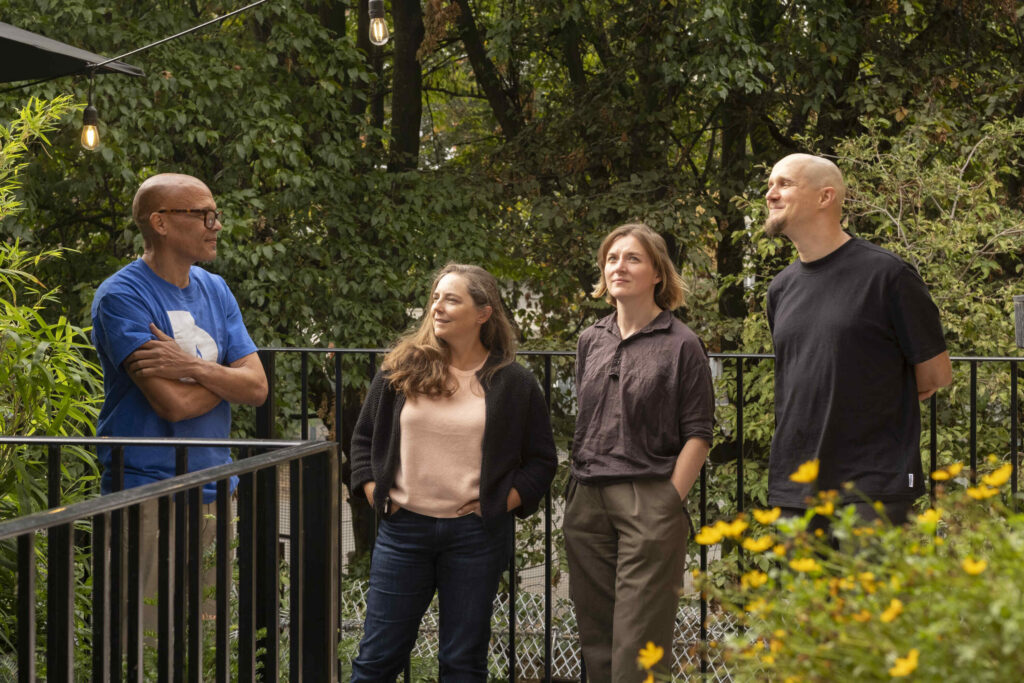
Catching up with CrossSense, winners of the Longitude Prize on Dementia
For me the most enjoyable bit of working on a Longitude Prize is right at the start, before we even open for entries. We take the time to do our research – reading up on the problems, on promising technical approaches; speaking to academics and entrepreneurs about what they’re working on; hearing from the people who would actually use the solutions we create.
That research then shapes the vision for the prize, the goal we set for innovators and – if all goes to plan – the innovations and the impact that will happen as a result.
But the most rewarding bit is at the end: seeing the winning innovation that brings that vision to life.
In spring 2026, we awarded the grand prize of our second Longitude Prize, which focused on assistive technology for people with dementia.
I recently had the pleasure of catching up with Szczepan Orlins, co-founder and CEO of CrossSense, the grand prize-winning team.
It’s been a busy few months for his company – packed with workshops, conferences and presentations – and with some big milestones along the path to commercialising their solution.
Szczepan writes:
Since winning the Longitude Prize on Dementia, we have turned the winning prototype into Wispy, a product getting ready for people’s homes.
We have spent considerable effort on our 4-week feasibility study, which is subject to ethics approval. About 12 people living with dementia and their care partners will use the smartphone version of Wispy at home for four weeks.
Wispy’s focus remains the same as before: it is an AI companion supporting the independence of people living with dementia through smart glasses. Wispy helps the person living with dementia orient themselves in their daily life, remembers them from one conversation to the next, and walks them through everyday activities they choose, one step at a time and at their own pace.
Over the next two months, we will run a small set of informal tests with friends and family (mostly people living with dementia who have previously tried CrossSense). We are now working towards a pilot starting in February 2027, with 25 dyads (a person living with dementia and a care partner) using Wispy in their own homes for 4 weeks. The pilot is the first step of our commercial launch. Households use Wispy as customers would, and we learn whether the product, the set-up and our support work in real homes. As a part of this effort we will be launching new a website and formalising our partnerships.
The pilot will be evaluated by Care City, an independent health and care innovation organisation in East London. The evaluation will look at how Wispy is used, what people make of it and how it fits into daily routines, with a follow-up for dyads that keep using it (at the end of the pilot, households can move straight into paid early access).
After the pilot is concluded, we will move to rolling CrossSense out to our early-access waiting list, which has grown to more than 600 people since the award, with the official launch in April 2027.
We are leading a bid to the NIHR Invention for Innovation Product Development Award, with the outline stage due in early December. If funded, the programme would run for about three years and end in a randomised controlled trial in people’s homes, comparing our approach with usual care, with health economics built in.
We keep the consumer product and clinical research apart. Wispy is a consumer product and makes no therapeutic claims. We are very excited to be developing a regulated version through clinical research with several universities and NHS Trusts (King’s College London / South London and Maudsley NHS FT, Oxleas FT, Northumbria University, Northumbria Healthcare NHS FT, University of Reading, University of Sussex).
I’m delighted to see that CrossSense are making progress towards commercialising their solution, getting it into users’ hands.
But I’m also thrilled to see that they’re building the evidence base through increasingly robust trials of their technology.
That was something we always wanted to incorporate into the prize itself. In the initial plans we sketched out, we would have awarded the prize only once the finalist teams had demonstrated, through a clinical trial, their ability to keep people living independently for longer.
In the end, the timelines and budget were against us. Fitting in a lengthy clinical trial would have eaten into the time our teams needed to develop their technologies – CrossSense’s planned trial is 3 years long, roughly the entire duration of the entire prize. Designing and delivering such a trial would also have taken too big a chunk out of the prize money. We took over two years to secure the multi-million pound support from the Alzheimer’s Society and Innovate UK we needed to launch the prize – more years of uncertainty and fundraising wouldn’t have served anyone.
It’s great to see that CrossSense are now going ahead with making that a reality.
We’re now exploring what the topic for the next Longitude Prize could be – there are 30 sketches of different possible focuses for it on our website. We’re planning a workshop to explore some more exciting opportunities in the field of AI in January (watch this space). If you have expertise in any of these topics and would like to feed back, we’d love to hear your thoughts.
But ultimately it comes down to money: a Longitude Prize needs a budget. So if you’re a funder, and you share our ambition – and want to join the ranks of Innovate UK, the Alzheimer’s Society, MND Association and others who have sponsored previous Longitude Prizes – we’d love to hear from you.