
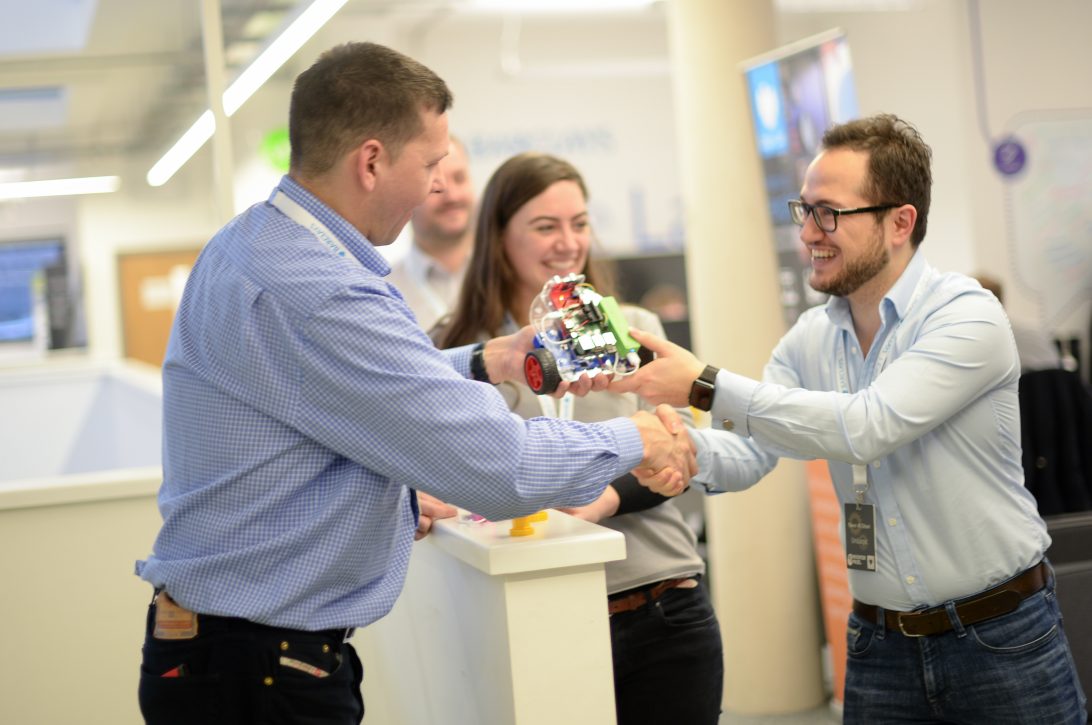
What was the Inventor Prize?
Funded by the Department for Business, Energy and Industrial Strategy (BEIS), the £50k Inventor Prize was launched as part of the government’s industrial strategy with the aim of supporting local innovation, business creation, and improving access to finance and management skills.
Why did we do this?
The prize supported individuals, teams and companies with ideas for products that would help improve people’s daily lives and to access resources and support. The Inventor Prize sought to:
- Support the development of selected products
- Build the capacity of prize participants (inventors)
- Champion and raise the profile of the lone or small-scale inventor
What happened?
The Inventor Prize was athematic, open to products that relate to any issue as long as that product helps to make people’s lives better. To be eligible, entrants had to have a working model and be able to show their invention would help to tackle an important social challenge.
- Over 180 applications
- 10 finalists all received a £5,000 grant towards their prototype development, business planning and user testing. They were also given non-financial support by Barclays Eagle Labs
- The winner was awarded £50,000 for business and product support
- Two runner-up prizes of £5,000 and £15,000 were also given for other promising products
- All finalists thought the experience of participating in the Inventor Prize was either good or very good
- Over 80% were able to secure additional funding, partnerships, clients and/or attract new investments for their solutions through the prize process
- 88% of finalists felt they were either ready or almost ready to go to market in less than 12 months
- All finalists were very likely to continue working on their solution, regardless on winning the prize money
- All finalists noted that the prize offered them credibility as an individual/team, but also validation of their solution
- Over 60% of finalists agreed/strongly agreed that they had improved their capabilities through the prize. This includes motivation, public profile, prototype development, business planning, marketing and communications, user-testing and impact and partnerships
- Alex Papanikolaou, founder of Freedom One Life
- Ana Avaliani, Head of the Enterprise Hub at the Royal Academy of Engineering
- Claire Mitchell, founder and inventor of Chillipeeps
- David Wardell, director of the Institute of Patentees and Inventors
- Dr Ian Brotherston, Head of Government Engagement at Innovate UK
- Sarah Drinkwater, director of Tech and Society Solutions Lab at Omidyar Network
- Tom Tobia, founder of Makerversity
- Tris Dyson, Managing Director of Challenge Works
Impact of the Prize
The winners
Gameball Platform
The winner, Gameball Platform, by Guillem Singla Buxarrais of Neurofenix Limited is a gamification of stroke rehabilitation with the invention of an easy-to-use hand-controller or Gameball. It allows users to play entertaining games, either solely or against other users, in the comfort of their own homes, with all games developed around motor learning research.
NuCath
NuCath by Nawar Al-Zebari of Urologic Ltd is a new catheter that uses smart technology and a simple design, cheaper and allows for better drainage. Aimed at lowering the 500,000 urinary tract infections contracted per year in the UK, and their estimated £2.7 billion cost to the NHS annually. They won a £15k Recognition Award.
Canute
Canute by Ed Rogers and Bristol Braille is a technology which loads text files by SD card or USB, whereupon it acts as a stand-alone ebook reader, much like a Kindle. Canute has been designed in close co-operation with a community of Braille users by microbusiness Bristol Braille. They won a £5k Recognition Award.
The Inventor Prize aimed to support local innovation, business creation, and improve access to finance and management skills
Over 80% of finalists
were able to secure additional funding, partnerships, clients and/or attract new investments for their solutions through the prize process
88% of finalists
felt they were either ready or almost ready to go to market in less than 12 months from the close of the prize
All finalists
were very likely to continue working on their solution, regardless of winning the prize money and noted that the prize offered them credibility as an individual/team